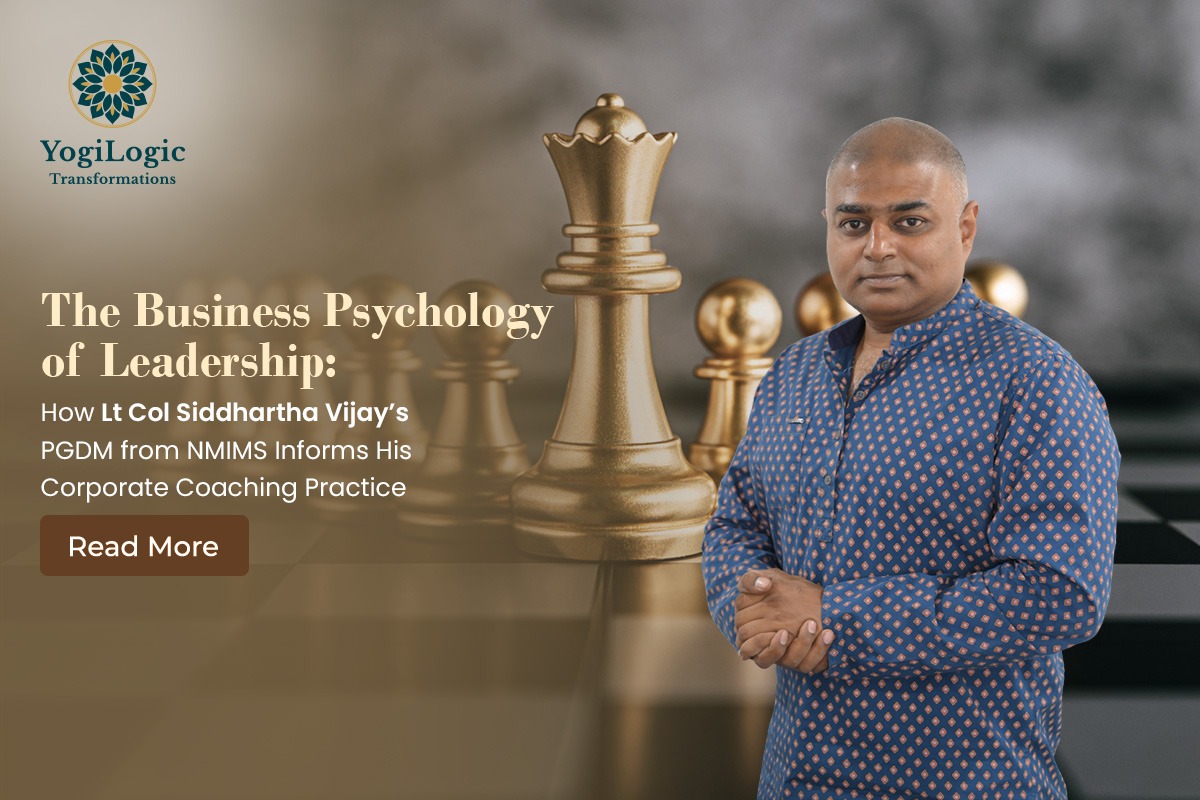
The Business Psychology of Leadership: How Lt Col Vijay's PGDM from NMIMS Informs His Corporate Coaching Practice
Modern organisations operate in an environment where constant change, increasing complexity, and growing performance expectations challenge leaders every day. Technical expertise alone is no longer enough to build resilient teams or sustain long term success. Effective leadership requires emotional intelligence, strategic thinking, communication, adaptability, and the ability to support people through uncertainty.
Corporate coaching has therefore become an essential investment for organisations seeking to improve leadership capability and employee wellbeing. However, meaningful coaching requires more than psychological knowledge. Coaches must also understand how businesses function, how organisations make decisions, and how leadership influences performance across every level of the workplace.
At YogiLogic Transformations, Lt Col Siddhartha Vijay brings together a unique combination of military leadership, psychological expertise, and formal business education. His PGDM in Business Management from NMIMS complements more than 22.5 years of distinguished service in the Indian Army and advanced training across multiple evidence based psychotherapeutic modalities. This multidisciplinary foundation allows him to help leaders move from complexity to clarity through practical and psychologically informed coaching.
Why corporate coaches need business literacy not just psychological training
Leadership coaching often focuses on confidence, communication, motivation, or emotional wellbeing. While these areas are important, coaching becomes significantly more effective when the coach also understands the business realities that leaders face.
Executives make decisions involving budgets, organisational priorities, stakeholder expectations, market competition, operational efficiency, and team performance. Without knowledge of these business challenges, coaching risks becoming disconnected from the realities of leadership.
Business literacy allows a coach to appreciate how psychological factors interact with organisational goals. Emotional resilience influences productivity. Decision making affects profitability. Communication shapes collaboration. Leadership behaviours influence culture, innovation, and employee engagement.
At YogiLogic Transformations, coaching bridges psychological science with practical business understanding so that personal growth directly supports organisational performance.
The PGDM in Business Management from NMIMS and what it covers
A Post Graduate Diploma in Business Management provides comprehensive understanding of the principles that drive successful organisations.
The programme offered through NMIMS develops knowledge across multiple management disciplines including leadership, organisational behaviour, strategic planning, finance, marketing, operations, human resource management, business communication, project management, and decision making.
These subjects provide valuable insight into how organisations function, how leaders influence teams, and how business decisions create long term organisational outcomes.
For Lt Col Siddhartha Vijay, this business education complements his extensive operational leadership experience within the Indian Army.
Rather than viewing leadership solely through a psychological perspective, he understands how organisational structures, performance expectations, resource management, and strategic planning interact with human behaviour.
This combination creates a more comprehensive coaching framework for corporate professionals and leadership teams.
Business psychology and the convergence of organisational science and clinical insight
Business psychology examines how people think, behave, communicate, and perform within organisational environments.
It draws upon organisational psychology, behavioural science, leadership research, cognitive psychology, and workplace wellbeing to improve both individual and organisational outcomes.
Clinical psychology contributes another important dimension by helping leaders understand emotional regulation, resilience, stress management, interpersonal relationships, and behavioural change.
At YogiLogic Transformations, these disciplines work together rather than separately.
A leader experiencing workplace stress may require emotional regulation strategies alongside improved delegation skills.
A manager struggling with conflict may benefit from communication coaching while also addressing underlying cognitive patterns that influence interpersonal relationships.
This integrated approach ensures that coaching addresses both the human and organisational aspects of leadership.
How management science informs leadership coaching
Management science provides structured frameworks for understanding organisational effectiveness.
Leaders constantly balance competing priorities including performance targets, employee wellbeing, innovation, customer satisfaction, operational efficiency, and strategic growth.
Leadership coaching becomes more valuable when these realities are incorporated into the coaching process.
At YogiLogic Transformations, coaching encourages leaders to develop clearer decision making processes, improve communication, strengthen emotional intelligence, manage uncertainty, and build resilient teams.
Psychological principles are translated into practical workplace applications rather than remaining theoretical concepts.
For example, cognitive flexibility helps leaders adapt during organisational change.
Self awareness improves conflict resolution.
Behavioural psychology supports habit formation.
Mindfulness enhances attention and emotional regulation during high pressure situations.
These evidence based strategies contribute to stronger leadership performance while supporting healthier workplace cultures.
Organisational psychology principles Lt Col Vijay applies in corporate training
Organisational psychology studies how individuals and groups function within workplace environments.
Several evidence based principles guide the corporate programmes delivered through YogiLogic Transformations.
Leadership development begins with increasing self awareness so that individuals understand how their thinking, communication, and behaviour influence team performance.
Psychological safety encourages employees to contribute ideas, ask questions, and learn from mistakes without unnecessary fear.
Resilience training helps professionals manage pressure while maintaining performance and emotional wellbeing.
Effective communication improves collaboration, trust, and conflict resolution across departments.
Motivation is strengthened by aligning organisational objectives with individual purpose and meaningful contribution.
Performance coaching focuses on sustainable excellence rather than short term productivity achieved through chronic stress.
These principles create workplaces where both people and organisations can thrive.
Rather than treating wellbeing and performance as competing priorities, YogiLogic Transformations recognises that they strengthen one another.
The military management convergence and shared principles of leadership science
Although military organisations and corporate businesses operate in different environments, they share many fundamental leadership principles.
Both require clear communication, disciplined execution, effective teamwork, ethical decision making, resilience under pressure, and continuous learning.
Throughout more than 22.5 years in the Indian Army, Lt Col Siddhartha Vijay led teams in demanding operational environments where effective leadership directly influenced mission success.
These experiences developed practical understanding of decision making under uncertainty, crisis leadership, resource management, accountability, and team cohesion.
His subsequent education in psychology and business management allows these lessons to be translated into modern corporate settings.
Military leadership does not simply emphasise authority.
It also requires empathy, trust, adaptability, emotional regulation, and responsibility for team wellbeing.
These same qualities increasingly define successful corporate leadership today.
The convergence of military experience, management science, and clinical psychology creates a distinctive coaching methodology that prepares leaders for both operational excellence and human centred leadership.
What differentiates YogiLogic corporate coaching from standard EAP provision
Many organisations provide Employee Assistance Programmes that offer confidential counselling services for employees experiencing personal or workplace challenges.
These programmes play an important role in supporting mental wellbeing.
However, corporate coaching at YogiLogic Transformations extends well beyond traditional Employee Assistance Programmes.
Rather than focusing only on resolving existing problems, YogiLogic develops leadership capability, emotional intelligence, resilience, communication skills, conflict management, performance optimisation, and organisational effectiveness.
Every engagement begins with thoughtful assessment rather than applying identical programmes across all organisations.
Depending on organisational needs, interventions may include leadership coaching, resilience workshops, executive development, team communication programmes, stress management training, motivational coaching, or organisational wellbeing initiatives.
The therapeutic foundation is equally distinctive.
Lt Col Siddhartha Vijay integrates evidence based approaches including Cognitive Behavioural Therapy, Acceptance and Commitment Therapy, Rational Emotive Behaviour Therapy, Positive Psychotherapy, Mindfulness Based Cognitive Therapy, Experiential Counselling, Transactional Analysis, Solution Focused Brief Therapy, Neuro Linguistic Programming, Art Therapy, Graphotherapy, Hypnotherapy, and other recognised modalities where appropriate.
This integration reflects the core philosophy of YogiLogic Transformations.
The Logic provides structured psychological science, analytical thinking, and evidence based practice.
The Yogi develops mindful awareness, emotional balance, resilience, and authentic leadership.
Together these elements create leaders who perform effectively while remaining grounded, emotionally intelligent, and capable of sustaining long term success.
Conclusion
Modern leadership requires much more than technical expertise or management experience. Organisations increasingly need leaders who understand both business strategy and human psychology. Sustainable success depends upon emotional intelligence, resilience, ethical decision making, communication, and the ability to guide people through constant change.
At YogiLogic Transformations, Lt Col Siddhartha Vijay brings together military leadership, clinical psychology, and formal business education through his PGDM in Business Management from NMIMS. This unique combination allows him to deliver corporate coaching that addresses both organisational performance and personal development.
By integrating evidence based psychological approaches with practical business understanding, YogiLogic Transformations helps leaders strengthen resilience, improve decision making, build healthier workplace cultures, and achieve sustainable peak performance.
Moving from complexity to clarity requires more than leadership theory. It requires disciplined thinking, compassionate leadership, and a scientifically informed understanding of how people and organisations succeed together.
Frequently Asked Questions
Why is business knowledge important for leadership coaching
Business knowledge helps coaches understand organisational challenges, strategic priorities, operational realities, and leadership responsibilities so that coaching remains practical and relevant.
How does a PGDM in Business Management support corporate coaching
A PGDM provides knowledge of leadership, organisational behaviour, strategic planning, finance, human resources, operations, and decision making, creating a stronger foundation for executive coaching.
What is business psychology
Business psychology studies how human behaviour, communication, motivation, leadership, and emotional wellbeing influence organisational performance and workplace effectiveness.
What organisations can benefit from YogiLogic corporate coaching
Corporate organisations, leadership teams, entrepreneurs, government institutions, educational organisations, startups, and businesses managing change or high performance environments can benefit from personalised coaching programmes.
How does Lt Col Siddhartha Vijay combine psychology with business leadership
He integrates his military leadership experience, business education, and professional psychological training to help leaders improve resilience, communication, decision making, emotional intelligence, and team performance.
How is YogiLogic corporate coaching different from Employee Assistance Programmes
Employee Assistance Programmes primarily provide counselling for existing concerns, while YogiLogic also focuses on leadership development, resilience, organisational effectiveness, communication, performance coaching, and long term professional growth.
Which psychological approaches are used during corporate coaching
Depending on organisational needs, coaching may integrate Cognitive Behavioural Therapy, Acceptance and Commitment Therapy, Rational Emotive Behaviour Therapy, Mindfulness Based Cognitive Therapy, Transactional Analysis, Positive Psychotherapy, Experiential Counselling, Solution Focused Brief Therapy, and other evidence based modalities.
Who should consider leadership coaching through YogiLogic Transformations
Senior executives, emerging leaders, managers, entrepreneurs, high performing professionals, and organisations seeking resilient leadership and sustainable workplace performance can benefit from the personalised coaching programmes offered by YogiLogic Transformations.
Related Articles
The Infantry Officers Guide to Managing Ambiguity: Psychological Lessons for Corporate Decision Makers
September 22, 2026

Positive Psychotherapy: Building Strengths Not Just Addressing Deficits The Philosophy Behind YogiLogic Growth Framework
September 15, 2026
Mindfulness Based Cognitive Therapy MBCT: The Evidence Based Approach to Breaking the Cycle of Recurrent Depression and Cognitive Reactivity
September 1, 2026